
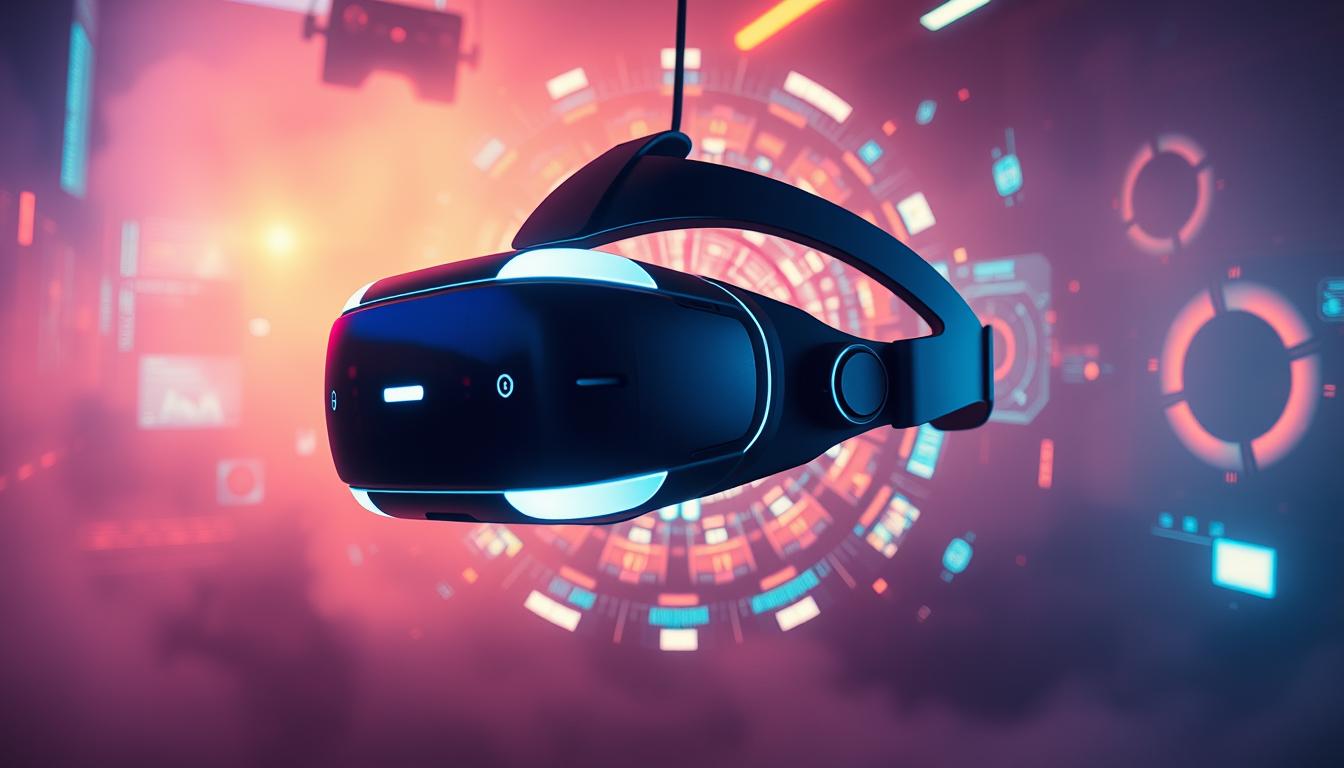
The world of technology is witnessing a significant transformation with the advent of Augmented Reality and Virtual Reality. These Immersive Technologies are revolutionizing the way we interact with digital content.
AR & VR Development is becoming increasingly popular, transforming industries such as gaming, education, and healthcare. As these technologies continue to evolve, we can expect to see even more innovative applications in the future.
The potential of Immersive Technology is vast, and its impact will be felt across various sectors. This article will explore the exciting world of AR & VR apps and their potential to revolutionize digital experiences.
Key Takeaways
- Understanding the basics of Augmented Reality and Virtual Reality.
- Exploring the current applications of AR & VR in various industries.
- Learning about the future potential of Immersive Technology.
- Gaining insights into the development process of AR & VR apps.
- Discovering the impact of AR & VR on digital content consumption.
The Evolution of Immersive Technology
The concept of immersive technology has long fascinated us, transitioning from science fiction to tangible reality. This evolution has been marked by significant milestones that have shaped the industry into what it is today.
From Fiction to Reality
Immersive technology, including Augmented Reality (AR) and Virtual Reality (VR), has its roots in science fiction. Early concepts were often depicted in literature and film, showcasing futuristic ideas that have since become a reality. The transition from fiction to reality has been driven by advancements in technology and computing power.
Key Milestones in AR & VR Development
Several key milestones have defined the evolution of AR and VR:
- The development of the first VR headsets in the 1960s
- The introduction of AR applications in the 1990s
- The release of consumer-grade VR headsets in the 2010s
Current State of the AR & VR Market
Today, the AR and VR market is experiencing rapid growth, driven by demand from various industries including gaming, education, and healthcare. The current market trends indicate a shift towards more sophisticated and user-friendly experiences, with significant investments being made in content creation and hardware development.
As immersive technology continues to evolve, we can expect to see even more innovative applications across different sectors, further blurring the lines between the physical and digital worlds.
Understanding the Difference: AR vs. VR vs. MR
The world of immersive technology is primarily driven by three distinct types of realities: Augmented Reality, Virtual Reality, and Mixed Reality. Each of these technologies offers unique experiences and applications, catering to different needs and industries.
Enhancing the Real World
Augmented Reality (AR) overlays digital information onto the real world, enhancing our interaction with the environment. AR is commonly experienced through smartphones and tablets, with applications like Pokémon Go and IKEA’s furniture placement tool.
Creating New Worlds
Virtual Reality (VR) immerses users in entirely digital environments, shutting out the physical world. VR headsets like Oculus and HTC Vive provide fully interactive experiences, revolutionizing gaming and simulation training.
Blending Digital and Physical
Mixed Reality (MR) combines elements of both AR and VR, allowing real-world and digital objects to interact. Microsoft’s HoloLens is a prime example of MR technology, offering applications in fields like education and architecture.
Essential Hardware for AR & VR Experiences
The world of AR and VR is heavily reliant on sophisticated hardware to deliver seamless experiences. To enjoy these immersive technologies to their fullest, understanding the essential hardware components is crucial.
VR Headsets and Systems
VR headsets are the cornerstone of virtual reality experiences, providing the visual and sometimes auditory immersion into virtual worlds. These headsets vary significantly in terms of technology, price, and functionality.
Key Features of VR Headsets:
- Resolution and Field of View
- Tracking Technology (Inside-out vs. Outside-in)
- Controllers and Interaction Methods
Standalone vs. Tethered Systems
VR systems can be categorized into standalone and tethered devices. Standalone headsets, like the Oculus Quest, are self-contained and don’t require a PC or console. Tethered headsets, such as the HTC Vive Pro, need to be connected to a powerful computer to operate.
| Feature | Standalone VR | Tethered VR |
|---|---|---|
| Processing Power | Integrated | External PC/Console |
| Cost | Generally Lower | Generally Higher |
| Graphics Quality | Limited by Hardware | High-End Graphics |
AR Devices and Platforms
AR technology overlays digital information onto the real world, enhancing the user’s environment. Devices range from smartphones with AR capabilities to dedicated AR glasses.
Notable AR Devices:
- Microsoft HoloLens
- Magic Leap One
- AR-enabled Smartphones
Input Controllers and Haptic Feedback
Input controllers are vital for interacting with virtual or augmented environments. Haptic feedback technology enhances the sensory experience by providing tactile sensations.
By understanding the different types of hardware available for AR and VR, users can make informed decisions about which devices best suit their needs and preferences.
AR & VR Apps: Building the Future of Immersive Experiences
The development of AR and VR apps is revolutionizing the way we interact with technology, creating immersive experiences that were once the stuff of science fiction. As these technologies continue to advance, they are opening up new possibilities for how we engage with digital content across various sectors.
Core Technologies Powering Immersive Apps
At the heart of immersive apps are several core technologies that enable their functionality. These include advanced computer vision, spatial audio, and sensor technologies that work together to create seamless and interactive experiences.
Key Technologies:
- Computer Vision: Enables devices to understand and interpret visual information from the environment.
- Spatial Audio: Provides a three-dimensional sound experience, enhancing the sense of immersion.
- Sensor Technologies: Includes GPS, accelerometers, and gyroscopes that track user movements and device orientation.
Development Frameworks and Tools
To create immersive apps, developers rely on a range of frameworks and tools that simplify the development process. Popular choices include Unity and Unreal Engine, which offer comprehensive platforms for building high-quality AR and VR experiences.
| Development Framework | Key Features | Platform Support |
|---|---|---|
| Unity | Cross-platform support, extensive asset store, robust community | iOS, Android, Windows, macOS, Linux, WebGL |
| Unreal Engine | High-performance graphics, physics-based rendering, Blueprints visual scripting | Windows, macOS, iOS, Android, HTML5 |
Design Principles for Immersive Experiences
Designing for AR and VR requires a deep understanding of user interaction and experience principles. Key considerations include intuitive controls, minimizing user discomfort, and creating engaging narratives.
By focusing on these aspects, developers can craft immersive experiences that captivate users and leave a lasting impression.
Revolutionary Applications in Entertainment and Gaming
Gaming and entertainment are being redefined by the power of immersive technologies. Augmented Reality (AR) and Virtual Reality (VR) are at the forefront of this revolution, offering experiences that were previously unimaginable.
Gaming Experiences Transformed
AR & VR have transformed the gaming landscape by providing immersive gaming experiences that engage players on a deeper level. Games like Pokémon GO have shown how AR can bring virtual elements into the real world, while VR games offer completely immersive environments that simulate the gaming world.
Interactive Storytelling and Cinematic VR
The rise of interactive storytelling and cinematic VR is changing how we consume media. These technologies allow for a more engaging and personal experience, enabling viewers to be part of the story. Cinematic VR, in particular, offers a new way to experience films, providing a 360-degree environment that enhances the narrative.
Live Events and Virtual Attendance
AR & VR are also revolutionizing live events by enabling virtual attendance. This technology allows people to participate in events remotely, breaking geographical barriers and expanding the reach of live performances and conferences.
The impact of AR & VR on entertainment and gaming is profound, offering new ways to engage audiences and create immersive experiences. As these technologies continue to evolve, we can expect even more innovative applications in the future.
AR & VR in Education and Training
The integration of Augmented Reality (AR) and Virtual Reality (VR) in education is transforming the way we learn. These technologies are not only making learning more engaging but also more effective by providing hands-on experiences.
Revolutionizing Classroom Learning
AR and VR are revolutionizing classroom learning by making it more interactive. For instance, students can use AR apps to visualize complex concepts in subjects like mathematics and science, making them easier to understand.
Professional Skills Training
AR and VR are also being used for professional skills training. They allow trainees to practice in a simulated environment, reducing the risk of errors and improving retention. For example, welding training can be conducted using VR, providing a safe and controlled environment.
Medical Education Applications
In medical education, AR and VR are being used to enhance learning. For instance, VR can be used to simulate surgeries, allowing medical students to gain experience without the risk of operating on real patients. A study on the effectiveness of VR in medical training is summarized in the table below.
| Training Method | Effectiveness | Retention Rate |
|---|---|---|
| Traditional | 60% | 40% |
| VR Training | 90% | 80% |

Business Applications and Enterprise Solutions
AR & VR are revolutionizing the way businesses operate, collaborate, and innovate. These technologies are not just transforming entertainment and gaming but are also having a significant impact on various business sectors.
Virtual Collaboration and Remote Work
The rise of remote work has necessitated the need for more effective virtual collaboration tools. AR & VR are stepping in to fill this gap by providing immersive environments where teams can collaborate more effectively. For instance, virtual reality can be used to create virtual meeting spaces where participants can interact as if they were in the same physical location.
Product Design and Visualization
AR & VR are transforming the product design and visualization process. Designers can use VR to create and interact with 3D models of products, allowing for more intuitive and immersive design experiences. AR can be used to visualize products in real-world environments, helping customers to better understand the product’s features and benefits.
Marketing and Customer Engagement
AR & VR are also being used to enhance marketing and customer engagement strategies. For example, AR can be used to create interactive advertisements that allow customers to engage with products in new and innovative ways. VR can be used to create immersive brand experiences that captivate and retain customers.
Real Estate and Architecture Applications
In the real estate and architecture sectors, AR & VR are being used to create immersive property tours and to visualize architectural designs. Potential buyers can use VR to explore properties remotely, while architects can use AR to visualize and interact with building designs in the context of their real-world surroundings.
By adopting AR & VR technologies, businesses can gain a competitive edge, improve operational efficiency, and create new opportunities for growth and innovation.
Healthcare Innovations Through Immersive Technology
Healthcare innovations through immersive technology are changing the way we approach medical treatment and training. The integration of Augmented Reality (AR) and Virtual Reality (VR) in healthcare is providing new avenues for therapeutic applications, surgical planning, and patient education.
Therapeutic Applications and Mental Health
Immersive technology is being increasingly used for therapeutic applications, particularly in the realm of mental health. VR exposure therapy, for instance, is being used to treat anxiety disorders and PTSD by simulating controlled environments that help patients confront their fears.
Therapeutic benefits include reduced anxiety and improved coping mechanisms. Studies have shown that VR therapy can be as effective as traditional methods, offering a promising alternative for patients.
Surgical Planning and Training
AR & VR are revolutionizing surgical planning and training by providing surgeons with immersive and interactive experiences. Surgeons can use VR to practice complex procedures and AR to visualize patient anatomy during surgery.
| Technology | Application | Benefit |
|---|---|---|
| VR | Surgical Training | Enhanced skill development |
| AR | Surgical Planning | Improved accuracy |
Patient Education and Rehabilitation
Immersive technology is also being used for patient education and rehabilitation. VR can help patients recover from injuries by engaging in interactive rehabilitation programs. Additionally, AR can be used to educate patients about their conditions and treatment options.
By leveraging AR & VR, healthcare providers can offer more engaging and effective treatment plans, ultimately improving patient outcomes.
Overcoming Technical Challenges in AR & VR Development
Creating immersive AR and VR experiences requires overcoming several technical challenges, from performance optimization to user interface design. As these technologies continue to advance, addressing these challenges is crucial for delivering high-quality user experiences.
Performance Optimization Strategies
One of the primary technical challenges in AR & VR development is optimizing performance. This involves ensuring that applications run smoothly on a variety of hardware configurations. Techniques such as level of detail (LOD) management, occlusion culling, and efficient use of GPU and CPU resources are essential for maintaining high frame rates and reducing latency.

User Interface Design Considerations
Designing intuitive user interfaces for AR & VR applications is another significant challenge. Developers must consider factors such as user comfort, ease of navigation, and the need for clear feedback. Implementing gesture-based controls and voice commands can enhance the user experience, making interactions more natural and immersive.
Addressing Motion Sickness and User Comfort
Motion sickness is a common issue in VR applications, caused by discrepancies between visual and vestibular cues. To mitigate this, developers can use techniques such as comfort modes, smooth locomotion, and ensuring that the user’s field of view is not unnecessarily strained. By prioritizing user comfort, developers can create more enjoyable and accessible AR & VR experiences.
Getting Started with AR & VR Development
To dive into AR & VR development, one must understand the essential skills, platforms, and technologies involved. This knowledge will serve as the foundation for creating innovative and immersive experiences.
Essential Skills and Learning Resources
Developing AR & VR applications requires a diverse skill set, including 3D modeling, programming, and user experience design. To acquire these skills, developers can leverage online courses, tutorials, and documentation provided by major development platforms.
- Online courses on platforms like Udemy and Coursera
- Tutorials and documentation from Unity and Unreal Engine
- Community forums and developer networks
Popular Development Platforms
The choice of development platform is crucial for the success of an AR & VR project. Two of the most popular platforms are Unity and Unreal Engine.
Unity and Unreal Engine
Unity is known for its versatility and ease of use, making it a favorite among indie developers and large studios alike. Unreal Engine, on the other hand, is renowned for its high-performance graphics capabilities and is often used in AAA game development and cinematic productions.
For developers focusing on augmented reality, ARKit (for iOS devices) and ARCore (for Android devices) are essential tools. These frameworks provide the necessary APIs and features to create immersive AR experiences.
Building Your First Immersive App
Once you have chosen your development platform and acquired the necessary skills, it’s time to start building your first AR or VR app. Begin with a simple project to get familiar with the development environment and gradually move on to more complex applications.
- Set up your development environment
- Create a simple AR or VR project
- Test and iterate on your application
Future Trends: What’s Next for AR & VR
Emerging trends in AR and VR are creating new opportunities for innovation and growth. As these technologies continue to evolve, we can expect significant advancements in various industries.
Innovations on the Horizon
The future of AR and VR is closely tied to emerging technologies that promise to enhance their capabilities. One such innovation is the development of more sophisticated haptic feedback systems, allowing for a more immersive experience.
Another area of growth is in standalone VR headsets, which no longer require a PC or console to operate, making VR more accessible to a wider audience.
The Metaverse and Digital Economies
The concept of the Metaverse has gained significant attention, representing a shared, immersive and interactive virtual real where users can create their own avatars and environments and engage with other users in real time.
| Metaverse Features | Benefits | Potential Applications |
|---|---|---|
| Interactive Environments | Enhanced User Experience | Gaming, Education, Social Media |
| Customizable Avatars | Increased Personalization | Virtual Events, Shopping |
| Real-time Interactions | Improved Engagement | Collaboration Tools, Entertainment |
Integration with AI, 5G, and IoT
The integration of AR and VR with AI, 5G, and IoT is set to unlock new possibilities. AI can enhance AR and VR by providing more personalized experiences, while 5G networks offer the high-speed data transfer required for seamless VR experiences.
IoT integration can further enhance AR and VR by connecting devices and allowing for more interactive and immersive experiences.
Conclusion
As we’ve explored throughout this article, AR & VR Apps are revolutionizing the way we experience the world. From entertainment and gaming to education and healthcare, Immersive Technology is transforming industries and creating new opportunities. The advancements in VR headsets, AR devices, and input controllers have enabled the development of sophisticated Immersive Experiences.
The potential of AR & VR extends beyond current applications, with emerging technologies like AI, 5G, and IoT set to further enhance their capabilities. As we move towards a more immersive future, it’s clear that AR & VR Apps will play a vital role in shaping our interactions, entertainment, and education.
With the Metaverse vision on the horizon, the possibilities for Immersive Technology are vast and exciting. As developers, businesses, and individuals continue to explore and innovate within this space, we can expect to see new and innovative applications of AR & VR that will further transform our world.
FAQ
What is the difference between AR and VR?
Augmented Reality (AR) enhances the real world by overlaying digital information, while Virtual Reality (VR) creates a completely new digital environment. AR is typically experienced through a smartphone or tablet camera, while VR requires a headset.
What are the most popular VR headsets available?
Some of the most popular VR headsets include Oculus Quest, HTC Vive, and PlayStation VR. These headsets offer a range of features, including resolution, field of view, and tracking capabilities.
How do I get started with AR and VR development?
To get started with AR and VR development, you’ll need to learn the necessary skills, such as programming languages like C# or Java, and familiarize yourself with development platforms like Unity or Unreal Engine. You can also explore online resources, tutorials, and courses to help you get started.
What are some of the most significant applications of AR and VR in education?
AR and VR are being used in education to create immersive and interactive learning experiences, such as virtual labs, historical reenactments, and interactive simulations. These technologies can enhance student engagement, understanding, and retention.
Can AR and VR be used for therapeutic purposes?
Yes, AR and VR are being used for therapeutic purposes, such as exposure therapy, pain management, and cognitive rehabilitation. These technologies can provide a safe and controlled environment for patients to confront and overcome their challenges.
What is the Metaverse, and how does it relate to AR and VR?
The Metaverse is a shared, immersive and interactive virtual world where users can create their own avatars and environments and engage with other users in real time. AR and VR are key technologies that can enable the Metaverse, providing a more immersive and interactive experience.
How do AR and VR impact the entertainment industry?
AR and VR are transforming the entertainment industry by providing new ways to experience movies, games, and live events. These technologies can create immersive and interactive experiences, enhancing the overall entertainment experience.
What are some of the technical challenges associated with AR and VR development?
Some of the technical challenges associated with AR and VR development include performance optimization, user interface design, and addressing motion sickness and user comfort. Developers must also consider factors like latency, resolution, and tracking capabilities.