
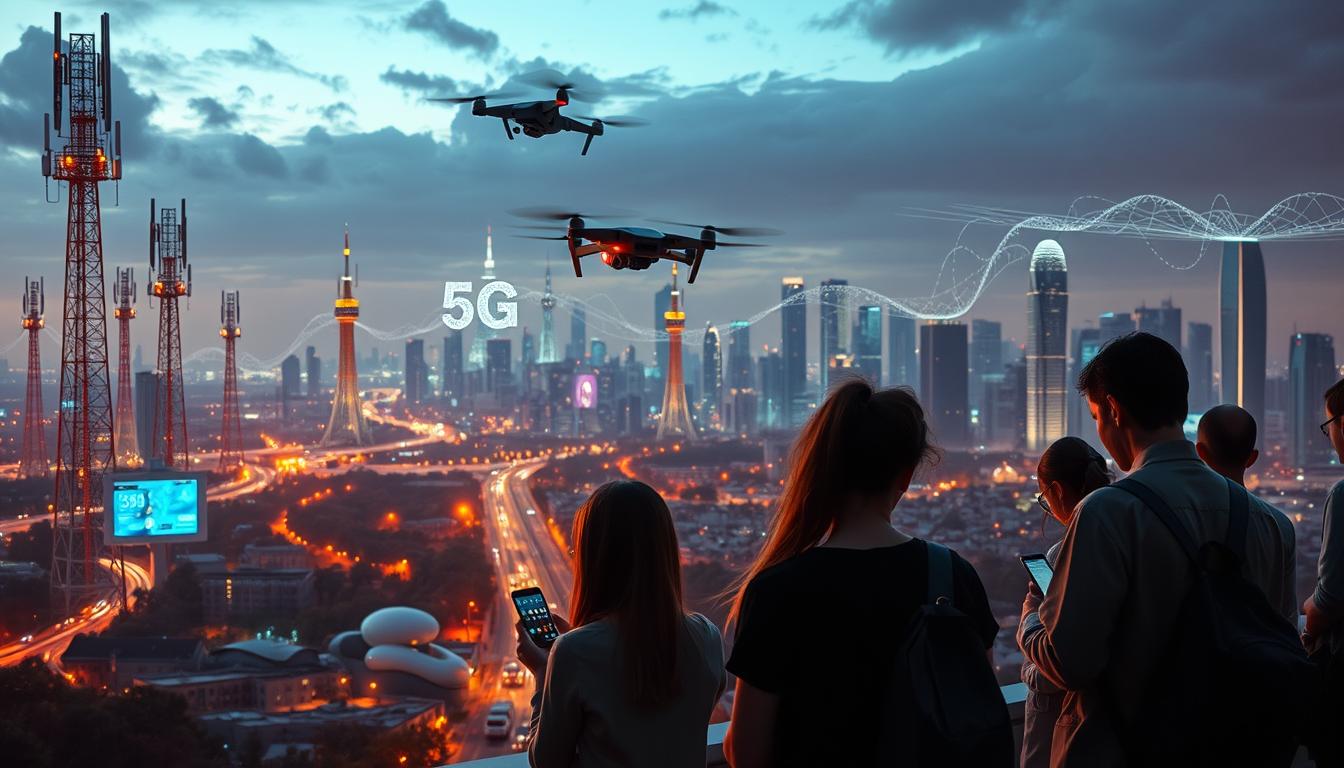
The advent of 5G technology is transforming the mobile app landscape at an unprecedented rate. With its promise of faster data speeds and lower latency, 5G is set to revolutionize the way mobile apps perform and interact with users.
The impact of 5G on mobile apps is multifaceted, enhancing not just the speed but also the overall user experience. As we dive into the specifics, we’ll explore how this technology is paving the way for more sophisticated and responsive mobile applications.
Key Takeaways
- Faster data speeds with 5G technology enhance mobile app performance.
- Lower latency improves the overall user experience.
- 5G enables more sophisticated and responsive mobile applications.
- The transformation is expected to impact various industries reliant on mobile apps.
- Better connectivity and speed open up new possibilities for app developers.
Understanding 5G Technology Fundamentals
As we delve into the world of 5G, it’s essential to understand the fundamental technologies that drive this next-generation network. The fifth generation of wireless technology is designed to provide faster data speeds, lower latency, and greater connectivity than ever before.
What Makes 5G Different from Previous Generations
5G technology represents a significant leap forward from its predecessors, primarily due to its use of new spectrum bands and advanced network architectures. Two key features that distinguish 5G are millimeter wave technology and network slicing capabilities.
Millimeter Wave Technology Explained
Millimeter wave technology operates on a much higher frequency band than previous generations, offering vast amounts of bandwidth. This enables faster data transfer rates and higher capacity. Millimeter wave technology is crucial for achieving the high speeds promised by 5G networks.
Network Slicing Capabilities
Network slicing allows multiple independent networks to coexist on the same physical infrastructure. This feature enables network operators to tailor network performance to specific use cases, such as enhanced mobile broadband or ultra-reliable low-latency communications.
Key Technical Specifications of 5G Networks
The technical specifications of 5G networks include peak data rates of up to 20 Gbps, latency as low as 1 ms, and the ability to support a vast number of devices. These specifications are made possible by advanced technologies such as massive MIMO and beamforming.
| Specification | Description | Benefit |
|---|---|---|
| Peak Data Rate | Up to 20 Gbps | Enhanced mobile broadband |
| Latency | As low as 1 ms | Real-time applications |
| Device Support | Vast number of devices | IoT and massive connections |
The Infrastructure Behind 5G Deployment
Deploying 5G requires significant infrastructure upgrades, including new base stations, small cells, and fiber optic cables. The infrastructure must support the high-frequency bands used by 5G and ensure widespread coverage.
According to a report by Ericsson, “5G will be a key enabler for a wide range of new use cases, from enhanced mobile broadband to mission-critical communications.” This highlights the importance of understanding 5G technology fundamentals.
“5G is not just a new generation of wireless technology; it’s a platform for innovation, enabling new services and business models.”
— GSMA
The Evolution from 4G to 5G: A Performance Leap
The leap from 4G to 5G is not just an incremental upgrade; it’s a transformative jump in mobile network capabilities. This evolution brings significant improvements in three key areas: speed, latency, and bandwidth.
Speed Comparisons Between 4G and 5G
The most noticeable difference between 4G and 5G is the substantial increase in data transfer speeds. While 4G networks typically offer peak speeds of up to 100 Mbps, 5G can reach speeds of up to 20 Gbps. This means that users can download and upload data much faster on 5G, enhancing overall mobile app performance.
| Network | Peak Speed |
|---|---|
| 4G | Up to 100 Mbps |
| 5G | Up to 20 Gbps |
Latency Improvements in the 5G Era
Latency, or the time it takes for data to travel from the device to the server and back, is significantly reduced in 5G networks. This improvement is crucial for real-time applications.
From 50ms to Sub-10ms Response Times
4G networks typically have a latency of around 50 ms. In contrast, 5G can achieve latencies as low as 1 ms. This drastic reduction enables smoother and more responsive interactions, particularly in applications that require real-time data processing.
Impact on Real-time Applications
The reduced latency in 5G has a profound impact on real-time applications such as online gaming, video conferencing, and virtual reality. These applications benefit from the instantaneous data transfer, providing a more seamless user experience.
“The low latency of 5G enables new use cases that were previously not possible, such as mission-critical communications and immersive technologies.” –
Industry Expert
Bandwidth Expansion and Its Implications
5G also offers a significant expansion in bandwidth, allowing for more data to be transmitted simultaneously. This increased capacity supports a higher density of devices on the network, making it ideal for IoT applications and large-scale deployments.
How 5G is Revolutionizing Mobile App Performance
The transition to 5G is ushering in a new era for mobile apps, characterized by enhanced performance and reliability. As 5G networks continue to roll out globally, the impact on mobile app performance is becoming increasingly evident.
Enhanced Data Transfer Capabilities
One of the most significant advantages of 5G is its ability to facilitate faster data transfer rates. With speeds that can reach up to 20 Gbps, 5G enables mobile apps to transfer large amounts of data quickly and efficiently. This is particularly beneficial for applications that require high-bandwidth, such as video streaming services and online gaming platforms.
Real-time Processing Possibilities
5G’s low latency opens up new possibilities for real-time processing in mobile apps. Applications that require instantaneous data processing, such as virtual reality (VR) and augmented reality (AR) experiences, can now operate seamlessly. This capability is set to revolutionize industries such as gaming, healthcare, and education.
Improved Reliability and Connection Stability
The reliability and connection stability offered by 5G networks are significantly improved compared to their predecessors. This is crucial for mobile apps that require consistent connectivity, such as those used in smart cities and IoT applications.
Reduced Packet Loss Benefits
5G networks are designed to minimize packet loss, ensuring that data is transmitted reliably. This reduction in packet loss is vital for applications that require real-time communication, such as video conferencing and online gaming.
Consistent Performance in High-Density Areas
Another key benefit of 5G is its ability to maintain consistent performance even in high-density areas. This is achieved through advanced technologies such as beamforming and massive MIMO, which enable networks to handle a large number of connections simultaneously without a drop in performance.
In summary, 5G is revolutionizing mobile app performance by enhancing data transfer capabilities, enabling real-time processing, and improving reliability and connection stability. As 5G continues to deploy globally, we can expect to see significant advancements in various industries that rely on mobile apps.
Mobile Gaming in the 5G Era
With 5G, mobile gaming is on the cusp of a revolution, offering experiences previously unimaginable. The enhanced capabilities of 5G networks are poised to transform the mobile gaming landscape, making it more immersive, interactive, and engaging.
Cloud Gaming Advancements
One of the most significant advancements in mobile gaming due to 5G is in cloud gaming. Cloud gaming allows for complex games to be processed remotely on servers, and then streamed to devices, reducing the need for powerful hardware on the user’s end.
Streaming Complex Games Without Downloads
Streaming complex games without downloads is now a reality, thanks to 5G. Gamers can access high-quality, graphics-intensive games directly on their mobile devices without the need for lengthy downloads or installations.
Reduced Input Lag for Competitive Gaming
The low latency of 5G networks also means reduced input lag, which is crucial for competitive gaming. Gamers can enjoy a more responsive and real-time gaming experience, giving them a competitive edge.
Multiplayer Gaming Experiences
5G is set to enhance multiplayer gaming experiences by providing a more stable and faster connection. This means smoother interactions and less lag, even in games with multiple players.
AR and VR Gaming Applications
The capabilities of 5G also open up new possibilities for AR and VR gaming applications. With the high-speed, low-latency connectivity of 5G, AR and VR games can offer more immersive experiences, blurring the lines between the virtual and real worlds.

The advent of 5G is a game-changer for mobile gaming, enabling new types of gaming experiences that are more engaging, interactive, and immersive. As 5G continues to roll out, we can expect to see even more innovative applications in the world of mobile gaming.
Streaming and Media Consumption Transformed
With the rollout of 5G networks, streaming and media consumption are undergoing a significant transformation. The enhanced capabilities of 5G are revolutionizing how we experience media, from higher quality video streaming to improved audio experiences.
4K and 8K Video Streaming Capabilities
The increased bandwidth and speed of 5G networks enable seamless 4K and 8K video streaming. This means that users can enjoy their favorite movies and shows in ultra-high definition without buffering or lag, enhancing their overall viewing experience.
Live Streaming Performance Enhancements
5G technology also significantly improves live streaming performance. With reduced latency and increased reliability, live events such as concerts, sports, and news broadcasts can be streamed in real-time, providing a more immersive experience for viewers.
Audio Quality Improvements for Music Apps
The advancements in 5G are not limited to video; they also enhance audio quality for music apps. Two key improvements include:
- Lossless Audio Streaming: Allowing for music to be streamed without compression, maintaining its original quality.
- Spatial Audio Experiences: Providing a more immersive listening experience by simulating the way sound behaves in the real world.
Lossless Audio Streaming Possibilities
Lossless audio streaming is a significant development for music enthusiasts. It ensures that the audio is transmitted without any loss of quality, offering a richer and more detailed sound.
Spatial Audio Experiences
Spatial audio technology creates a three-dimensional sound field, making the listening experience more engaging. This technology is particularly beneficial for music and audio content that is mixed to take advantage of spatial audio capabilities.
IoT and Connected Applications: The 5G Advantage
5G technology is set to unlock the full potential of IoT applications, enabling new use cases and improving existing ones. With its faster data transfer rates and lower latency, 5G is poised to revolutionize the way IoT devices operate and interact.
Smart Home Applications and Performance
The smart home industry is one of the primary beneficiaries of 5G-enabled IoT applications. With 5G, smart home devices can communicate more efficiently, enabling seamless control and automation. This leads to enhanced user experiences, with faster response times and more reliable connections.
Industrial IoT Use Cases
In industrial settings, 5G is transforming IoT applications by enabling more sophisticated use cases. Two significant areas of impact are remote equipment monitoring and predictive maintenance.
Remote Equipment Monitoring and Control
With 5G, industries can monitor equipment in real-time, allowing for swift decision-making and reduced downtime. This capability is particularly valuable in sectors where equipment failure can have significant financial and safety implications.
Predictive Maintenance Applications
Predictive maintenance is another area where 5G-enabled IoT applications are making a significant impact. By analyzing data from equipment sensors, predictive maintenance systems can forecast potential failures, enabling proactive maintenance and reducing the likelihood of unexpected downtime.
Wearable Technology and Health Applications
5G is also enhancing wearable technology and health applications. With faster data transfer rates, wearables can provide more detailed and timely health monitoring, enabling better health outcomes and more personalized care. This is particularly significant for applications that require real-time data analysis, such as remote patient monitoring.
Real-World Case Studies of 5G-Enhanced Apps
The advent of 5G technology has revolutionized the mobile app landscape, enabling developers to create more sophisticated and responsive applications. As we explore the real-world impact of 5G on mobile apps, we find numerous examples across various sectors.
Enterprise Applications Leveraging 5G
Enterprises are harnessing 5G to enhance their operations and services. For instance, manufacturing companies are using 5G-enabled IoT devices to streamline production processes, while logistics firms are leveraging 5G for real-time tracking and monitoring.
Success Stories and Performance Metrics
A leading automotive manufacturer implemented a 5G-enabled smart factory, achieving a 30% increase in production efficiency. The high-speed, low-latency connectivity allowed for seamless communication between machines and real-time data analysis.
| Industry | 5G Application | Performance Improvement |
|---|---|---|
| Manufacturing | Smart Factory | 30% |
| Logistics | Real-time Tracking | 25% |
Consumer Apps Redesigned for 5G Capabilities
Consumer apps are being revamped to take advantage of 5G’s capabilities. Streaming services are enhancing video quality, while gaming apps are utilizing 5G’s low latency for more responsive experiences.
Early adopters of 5G-enabled consumer apps have shown a significant increase in engagement. For example, a popular streaming service reported a 40% increase in 4K streaming usage on 5G networks compared to 4G.
Emerging Startups Built on 5G Technology
Startups are innovating with 5G, developing new applications that were previously not possible. AR and VR startups are creating immersive experiences that leverage 5G’s high-speed connectivity.
Challenges and Limitations in the 5G App Ecosystem
The rollout of 5G technology is not without its challenges. As the ecosystem evolves, several limitations are becoming apparent, affecting both developers and consumers.
Coverage and Accessibility Issues
One of the primary challenges facing the 5G app ecosystem is the issue of coverage and accessibility. Despite the rapid expansion of 5G networks, uneven coverage remains a significant hurdle, particularly in rural and underserved areas.
Device Compatibility Considerations
Another limitation is device compatibility. Not all devices are equipped to handle 5G speeds, and incompatibility can lead to a subpar user experience. Developers must consider these limitations when designing apps.
Battery Consumption Concerns
Battery consumption is also a concern, as 5G connectivity can drain device batteries more quickly. To mitigate this, developers are exploring power management strategies.
Power Management Strategies
Effective power management is crucial for optimizing 5G app performance. Techniques such as adaptive bitrate streaming and efficient data transfer protocols can help reduce battery consumption.
Hardware Limitations
Hardware limitations also play a significant role in the 5G app ecosystem. The need for more powerful processors and advanced cooling systems can be a barrier for some device manufacturers.
| Challenge | Description | Potential Solution |
|---|---|---|
| Coverage Issues | Limited 5G coverage in rural areas | Infrastructure investment |
| Device Incompatibility | Not all devices support 5G | Develop for backward compatibility |
| Battery Consumption | 5G drains battery faster | Implement power-saving techniques |

Developer Strategies for Optimizing Apps for 5G
The advent of 5G is revolutionizing the mobile app landscape, necessitating a fresh approach to app development and optimization. As developers, understanding how to leverage 5G’s capabilities is crucial for creating high-performance apps.
Backend Architecture Adjustments
One of the key areas where developers can optimize their apps for 5G is in the backend architecture. This involves making significant adjustments to take full advantage of 5G’s high-speed, low-latency networks.
Edge Computing Integration
Edge computing is a critical component in optimizing apps for 5G. By processing data closer to the user, edge computing reduces latency and improves real-time processing capabilities. This is particularly beneficial for applications that require instant feedback, such as gaming or virtual reality experiences.
Distributed Processing Models
Distributed processing models are another strategy for optimizing backend architecture. By distributing tasks across multiple servers or nodes, developers can improve the scalability and reliability of their apps, ensuring they can handle the increased traffic and data processing demands of 5G networks.
API Design for High-Speed Networks
API design is also crucial when optimizing apps for 5G. Developers need to ensure that their APIs are capable of handling the high-speed data transfer rates and low latency that 5G offers. This may involve optimizing API endpoints for faster data retrieval and processing.
Here’s a comparison of API design considerations for 4G vs. 5G networks:
| Design Consideration | 4G Networks | 5G Networks |
|---|---|---|
| Data Transfer Rate | Up to 100 Mbps | Up to 20 Gbps |
| Latency | 50-100 ms | 1 ms |
| API Optimization | Focused on reducing data payload | Focused on real-time processing and low latency |
Testing and Quality Assurance in a 5G Environment
Testing and quality assurance are critical steps in ensuring that apps are optimized for 5G. This involves testing apps under various 5G network conditions to identify and fix performance issues. Developers should also invest in quality assurance processes that can simulate 5G environments to ensure their apps perform well under different scenarios.
By adopting these strategies, developers can ensure their apps are optimized for the 5G era, providing users with faster, more reliable, and more responsive experiences.
The Business Impact of 5G on the App Economy
The 5G revolution is poised to significantly alter the landscape of the app economy. As 5G networks continue to expand globally, businesses are presented with new opportunities for growth and innovation.
New Revenue Models Enabled by 5G
5G technology enables new revenue streams through enhanced data transfer capabilities and lower latency. For instance, cloud gaming and AR/VR applications can now generate revenue through subscription-based models or in-app purchases.
Competitive Advantages for Early Adopters
Early adopters of 5G technology can gain a competitive edge by leveraging its capabilities to offer superior user experiences. This can lead to increased customer loyalty and retention.
Market Expansion Opportunities
5G opens up new markets and opportunities for app developers. With its enhanced capabilities, developers can now target new industries and demographics.
Industry-Specific Growth Projections
Various industries are expected to see significant growth due to 5G. For example, the healthcare industry can benefit from remote patient monitoring, while the entertainment industry can leverage 5G for immersive experiences.
Consumer Spending Trends on 5G-Optimized Apps
As 5G adoption increases, consumer spending on 5G-optimized apps is expected to rise. A recent study projects that the global 5G market will reach $1.8 trillion by 2025.
| Industry | Growth Projection | Key Applications |
|---|---|---|
| Healthcare | 20% increase | Remote patient monitoring, telemedicine |
| Entertainment | 30% increase | Immersive experiences, cloud gaming |
| Gaming | 25% increase | Cloud gaming, AR/VR gaming |
In conclusion, 5G is set to revolutionize the app economy by enabling new revenue models, providing competitive advantages, and opening up new market opportunities.
Conclusion: The Future of Mobile Apps in a 5G World
The advent of 5G is revolutionizing the mobile app landscape, enabling faster data transfer, real-time processing, and improved reliability. As we’ve explored throughout this article, 5G is transforming mobile gaming, streaming, and IoT applications, opening up new possibilities for developers and users alike.
In a 5G world, the future of mobile apps is bright, with emerging technologies like augmented reality and virtual reality becoming increasingly viable. As 5G continues to roll out globally, we can expect to see new revenue models, competitive advantages, and market expansion opportunities.
The potential of 5G to enhance mobile app performance and user experience is vast, and developers who optimize their apps for 5G will be well-positioned to capitalize on these opportunities. As the 5G ecosystem continues to evolve, it will be exciting to see the innovative applications and services that emerge.
FAQ
What is 5G and how does it differ from 4G?
5G is the fifth generation of wireless technology, designed to provide faster data speeds, lower latency, and greater connectivity than its predecessor, 4G. It achieves this through advancements like millimeter wave technology and network slicing.
How does 5G improve mobile app performance?
5G enhances mobile app performance by offering faster data transfer rates, reduced latency, and improved reliability. This enables smoother, more responsive experiences, especially for real-time applications like gaming and video streaming.
What are the benefits of 5G for mobile gaming?
5G brings several benefits to mobile gaming, including reduced input lag, faster game loading times, and the ability to support complex, high-quality games through cloud gaming. It also enhances multiplayer experiences and enables more sophisticated AR and VR applications.
How does 5G impact streaming and media consumption?
5G significantly improves streaming and media consumption by enabling 4K and 8K video streaming, enhancing live streaming performance, and providing higher quality audio. It also supports lossless audio streaming and spatial audio experiences, enriching the overall media consumption experience.
What are the advantages of 5G for IoT applications?
5G offers several advantages for IoT applications, including improved connectivity, lower latency, and greater reliability. This enhances the performance of smart home devices, industrial IoT use cases, and wearable technology, among others.
What challenges does the 5G app ecosystem face?
The 5G app ecosystem faces challenges such as coverage and accessibility issues, device compatibility considerations, and battery consumption concerns. Addressing these challenges is crucial for the widespread adoption and success of 5G-enabled apps.
How can developers optimize their apps for 5G?
Developers can optimize their apps for 5G by making backend architecture adjustments, such as integrating edge computing and adopting distributed processing models. They should also consider API design for high-speed networks and implement rigorous testing and quality assurance practices in a 5G environment.
What is the business impact of 5G on the app economy?
5G is expected to have a significant business impact on the app economy by enabling new revenue models, providing competitive advantages for early adopters, and opening up market expansion opportunities. It is likely to drive industry-specific growth and influence consumer spending trends on 5G-optimized apps.